Ali decides to lie. Aristotle decides to tell the truth. John controls his anger. Sofia plans revenge. Who is actually making these decisions? It is the frontal lobe, the region right behind the forehead that controls judgment, impulse, and moral choice. Now here is the striking part. The Qur’an described a “lying, sinful forelock” in Surah Al Alaq. Why would the forelock be called sinful? Is it coincidence, metaphor, or something deeper? Let us decipher this and understand the forelock in Surah Alaq.
Blog Summary:
- The Historical Perspective of the Quranic Verse
- Decoding Chapter 96 (Surah Al-Alaq), Verses 15–16
- The Brain’s Boss: Frontal Lobe and Prefrontal Cortex Explained
- Frontal Lobe Syndrome
- Early Forebrain Experiments, Lobotomies, and False Hope
- The “Sinful Forehead” Miracle: Why the Qur’an Used This Phrase
- Prophet Muhammad’s (pbuh) Duʿa About the Forelock
- Why I Don’t Feel the Power in My Prayers
Abu Jahl vs. the Forelock in Surah Alaq: When Arrogance Met Divine Truth
Abu Jahl1 was one of the fiercest opponents of Prophet Muhammad in Makkah. His real name was Amr ibn Hisham, yet due to his persistent rejection and hostility toward Islam, he became known as Abu Jahl., meaning the father of ignorance. He was a powerful leader of the Quraysh and is directly connected to the verses in Surah Al Alaq about the lying, sinful forelock.
Allah didn’t let his arrogance slide. He gets a pretty direct mention in the Qur’an.
“But no! If he (Abu Jahl) does not desist, We will certainly drag him by the forelock a lying, sinful forelock”2
So, what exactly does the Qur’an reveal about the forelock, and What the Forelock Means in Surah Al-Alaq?
What is the significance of “catching him by the forelock”?
The Forelock in Surah Al-Alaq
Imam Ahmad recorded in his Musnad that the Messenger of Allah, peace be upon him, said:
“A servant is not struck by worry or grief but let him say, ‘O Allah, I am Your servant, the son of Your servant, the son of Your maidservant. My forelock is in Your hand (you have total mastery over me), Your decision over me has passed, and Your decree upon me is in justice…..” 3
Okay, it might sound a little dramatic, but guess what? That “forelock”, the spot hidden right under your forehead, is basically the boss of your brain! 🧠👑 It’s the control center that helps you make decisions, control your impulses, and figure out how to behave like a decent human (most of the time 😅).
So, here’s a quick brain tour! The human brain is broadly divided into three main parts. The forebrain, the midbrain, and the hindbrain. Each part has its own role in keeping us alive, aware, and functioning.
The forebrain is the largest and most developed part, especially in humans. It includes the cerebrum, thalamus and limbic system. The cerebrum is further divided into four lobes, which are:
- Frontal lobe
- Occipital lobe
- Temporal lobe
- Parietal lobe
Now, the forelock is actually the frontal lobe, but more specifically, the superstar called the prefrontal cortex. This little brain powerhouse sits right behind your forehead and is basically your brain’s CEO. It’s the place where you decide what to do next, plan your day, stop yourself from eating that extra slice of cake 🍰 (or not), and figure out what’s right or wrong.
In other words: all the complicated stuff that makes you “you” happens here.
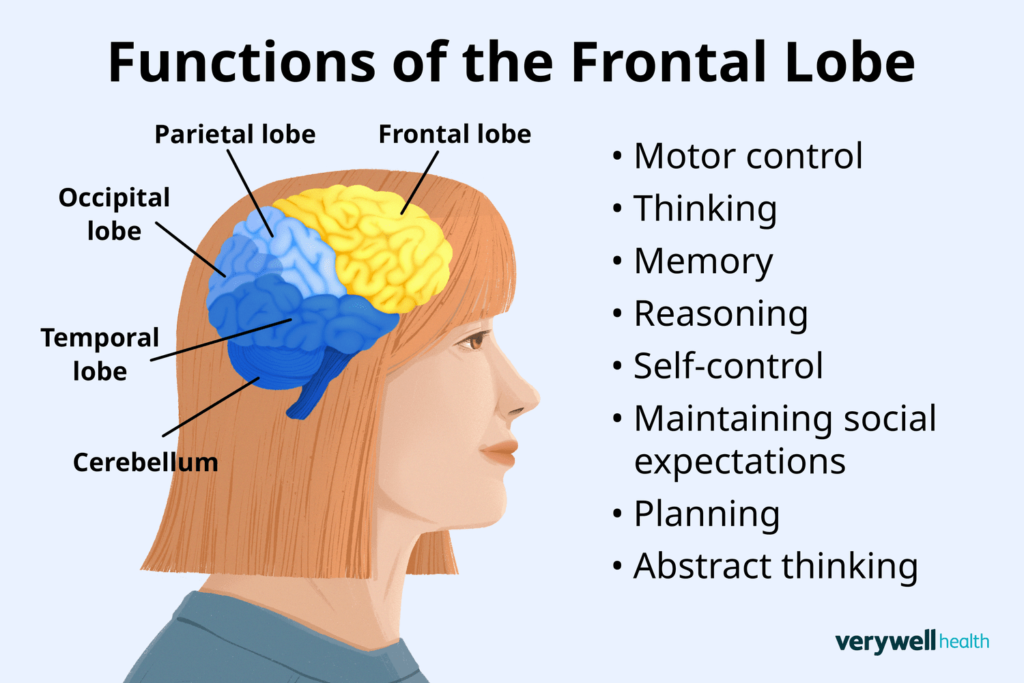
Forelock in Surah Alaq https://www.verywellhealth.com/frontal-lobe-8690029
The Frontal Lobe Breakdown – Forelock in Surah Alaq
The frontal lobe can be compared to a well-designed apartment with three main rooms. In fact, each section has a specific role. These are:
- Primary motor cortex
- Supplemental and premotor cortex
- Prefrontal cortex: The big boss, handles personality, judgment, and making smart (or sometimes silly) decisions
The Prefrontal Cortex — Your Brain’s VIP
Sitting right behind your forehead, this is the largest part of the frontal lobe. It shapes your personality, gives you that spark of motivation, and helps you judge situations, like when to speak your mind or just smile and nod 😅.
So next time you’re proud of a smart decision or resisting temptation, give a little shoutout to your forelock. It’s working hard behind the scenes! 🙌💡
Frontal Lobe Syndrome
Frontal lobe syndrome is a real neurological condition that occurs when the frontal lobe is damaged due to injury, stroke, tumor, infection, or degenerative disease. Because the frontal lobe is responsible for executive functions such as planning, impulse control, judgment, social behavior, and personality regulation, damage can lead to noticeable behavioral and emotional changes.
Common symptoms can include (according to National Library of Medicine4) loss of inhibition (a person loses the mental “brakes” that normally stop them from saying or doing inappropriate things.), poor decision making, difficulty planning, reduced motivation, emotional flatness, and personality changes. Patients may also have difficulty understanding other people’s feelings, which can affect relationships.
However, one clarification is important. Not every patient loses morality completely, and not all cases look the same. The symptoms depend on which part of the frontal lobe is damaged and how severe the injury is.
The Early Experiments and how it explains Forelock in Surah Alaq
Now this is the important part. If we really want to understand the importance of the frontal lobe, we should ask a simple question. What happens when it is damaged?
We do not need to run new experiments. History has already done that for us.
In the early twentieth century, John Fulton 5conducted experiments on chimpanzees. When their frontal lobes were damaged, the animals became unusually calm. Aggression reduced. They appeared peaceful.
At first glance, that sounded like success. But was it really peace, or was it something missing?
Lobotomies and False Hope
Inspired by such findings, Egas Moniz6 began performing lobotomies on human patients in the 1930s. The idea was simple. If the frontal lobe is responsible for emotional distress, then altering it might reduce anxiety and depression.
And initially, many patients did seem calmer. Families felt relieved. Doctors felt hopeful. For this work, Moniz even received a Nobel Prize.
It looked like progress. It felt like breakthrough medicine. But medicine sometimes celebrates too early.
The Ice Pick Era
Then came Walter Freeman7. He developed what was called the transorbital lobotomy. Instead of complex surgery, he inserted a sharp instrument through the eye socket to damage the frontal lobe. The procedure was quick. It could be done in minutes.
Meanwhile, families brought their loved ones, hoping for healing and relief. Doctors genuinely believed they were offering a solution to deep suffering. However, they did not yet understand the long-term consequences. In fact, few people questioned the risks at the time. As a result, hope moved faster than caution.
The Human Cost
With time, the deeper consequences became clear. Yes, patients were calmer. But many were also emotionally empty. Motivation faded. Personality softened into something flat. Ambition disappeared.
Some lost their sense of identity altogether.One heartbreaking example is Rosemary Kennedy8. After her lobotomy, she was left severely impaired for the rest of her life.
History began to speak for itself. Eventually, as psychiatric medications were developed and long term damage became undeniable, lobotomies were abandoned.
And what did we learn? We learned that the frontal lobe is not just a piece of tissue. It is the seat of judgment. The regulator of emotion. The filter of morality. The architect of personality.
When it is damaged, calmness may come. But something deeply human can be lost.
Forelock in Surah Alaq says Sinful Forehead?
When you tell a lie, your forehead’s brain (called the prefrontal cortex) gets super busy trying to keep the story straight! People who lie a lot have brains that work extra hard up there. So that “sinful forehead” the Qur’an talks about? It’s like saying, “Hey, this part of your brain gets all tangled up when you’re being sneaky!”
“But no! If he (Abu Jahl) does not desist, We will certainly drag him by the forelock a lying, sinful forelock”. The Qur’an describes the forelock of Abu Jahl as lying and sinful. It is because of this that it deserves burning in Hell.
The dua of Prophet Muhammad and Forelock in Surah Alaq
The Messenger of Allah, peace and blessings of Allah be upon him, used to say in his supplication:
“O Allah, I am Your servant, son of Your servant, son of Your maidservant, my forelock is in Your hand (i.e. You have total control over it), Your command over me is forever executed, and Your decree over me is just.” 9
The Forehead in Sajda and Forelock in Surah Alaq
When a Muslim performs sajda (prostration), the forehead touches the ground. The very place that houses judgment, pride, and planning is lowered in humility.
It is symbolic. The intellect bows. The will surrenders. There is also a supplication attributed to Muhammad in which he prays that his forelock be in the hand of Allah as I have mentioned earlier. It is a declaration that even our decision making power belongs to God. So, this is what we do when we prostrate, we say that we are nothing, help us, guide us, forgive us and ٱهْدِنَا ٱلصِّرَٰطَ ٱلْمُسْتَقِيمَ10.
Why I Don’t Feel the Power in My Prayers. Forelock in Surah Alaq helped me understand this
There is a question that always comes to my mind: why can’t I feel the love, the power in my prayers? The answer is actually very simple. I don’t even realize what I’m doing, what I’m feeling while I’m praying. That’s why I can’t understand the deeper meaning of it.
Symbolically, when I bow and place my forehead on the ground, I am surrendering my thoughts, my ego, my control, but if I don’t truly notice it, I miss the love, I miss the connection. It’s not that the prayer is empty; it’s that I’m not fully present. And maybe that’s why sometimes it feels like nothing is reaching me. It’s beautifully said by Hafeez Jalandhari:
سرکشی نے کر دیے دھندلے نگوشے بندگی
آؤ سجدے میں گریں لوہے جبیں تازہ کریں۔
Translation: When we are proud or rebellious, our devotion and connection to God become weak. By humbling ourselves in sajda (prostration), we can refresh our mind, heart, and spirit, letting clarity and strength return. It’s about surrendering our ego to regain true focus and humility.
And that’s the power of the forelock bowing to Allah, total trust, total peace. 🌟
“Indeed, prayer prohibits immorality and wrongdoing, and the remembrance of Allah is greater. And Allah knows that which you do”.11
Here is a blog that can now answer your question right now:
Free Will vs Predestination: My Fate is prewritten?
If Allah Loves Us, Why Is There Evil in the World? A Merciful Perspective
My final words about Forelock in Surah Alaq
The glorious Quran says:
“We will show them Our signs in the universe and within themselves until it becomes clear to them that this ˹Quran˺ is the truth. Is it not enough that your Lord is a Witness over all things?”12
Some people require only one sign, while others require numerous signs to embrace the truth. On the other side, there are others who, even after receiving thousands of indications, refuse to embrace the reality. The Quran describes these persons as:
“They are ˹wilfully˺ deaf, dumb, and blind, so they will never return ˹to the Right Path˺.”13
The Bible says the same thing:
“Though seeing, they do not see; though hearing, they do not hear or understand.”14
The Quran isn’t just a book; rather, it carries a living miracle within its words. 📖
In just one sentence, Allah can reveal layers of wisdom that scholars spend lifetimes exploring.
Long before science caught up, the Quran spoke of embryos, the expanding universe, mountains as pegs, and the water cycle.
It’s like Allah said, “I created the universe… of course I can explain it better than anyone!”
So which of the favors of your Lord would you deny?
Wanna know more about me? Here is the link of my official social media accounts:
https://www.instagram.com/ayhianali
https://youtube.com/@ayhian?si=j79tW8ppvqbhBmdX
Categories that will win your heart
- His real name was Amr ibn Hisham. He was a powerful leader of Quraysh and one of the fiercest opponents of Prophet Muhammad in Makkah. He served as a leading commander of the Quraysh army in the Battle of Badr and was killed in that battle at around seventy years of age. ↩︎
- Chapter 96 (Surah Al-Alaq) verse 15-16 ↩︎
- Musnad Aḥmad 3712 ↩︎
- https://www.ncbi.nlm.nih.gov/books/NBK532981/#:~:text=Although%20the%20etiology%20may%20range,changes%20in%20frontal%20lobe%20disorders. ↩︎
- John Fulton An American neuroscientist in the early twentieth century who studied the frontal lobe through experiments on chimpanzees. ↩︎
- Egas Moniz A Portuguese neurologist who introduced prefrontal lobotomy in 1935. He was awarded the Nobel Prize in Physiology or Medicine in 1949 for this work, which was later heavily criticized due to long term consequences. ↩︎
- Walter Freeman An American physician who popularized the transorbital lobotomy in the 1940s. He personally performed or supervised approximately 3,500 lobotomies in the United States, often promoting the procedure as quick and effective. ↩︎
- Rosemary Kennedy Born in 1918, she underwent a lobotomy in 1941 at age 23, which left her permanently incapacitated. The decision was approved by her father, Joseph Kennedy Sr., reportedly without fully informing her mother. Rosemary lived with severe impairment until her death in 2005 at the age of 86, and her case later became one of the most cited tragedies of lobotomy history.
https://en.wikipedia.org/wiki/Rosemary_Kennedy ↩︎ - Hisn al-Muslim 120 ↩︎
- Guide us along the Straight Path, Chapter 1 (Surah Al-Fatihah) verse 6 ↩︎
- Chapter 29 (Surah Al-Ankaboot) verse 45 ↩︎
- Chapter 41 (Surah Fussilat ) verse 53 ↩︎
- Chapter 2 (Surah Al-Baqarah) verse 18 ↩︎
- Gospel of Matthew verse 13 of chapter 13 ↩︎